
Tube-to-Tubesheet Welding and Expansion: A Practical Guide for Heat Exchanger Engineers
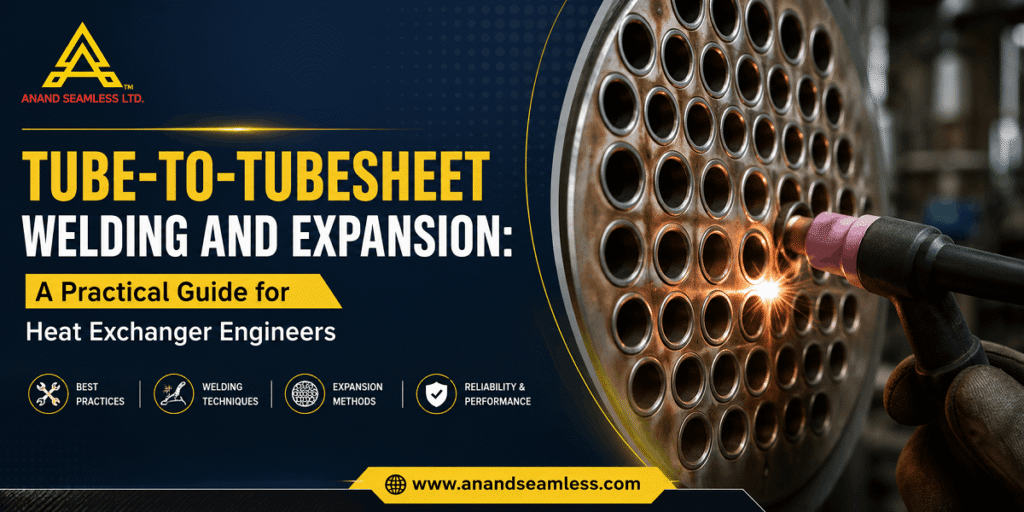
Tube-to-tubesheet (TTS) joints connect heat exchanger tubes to the tubesheet plate using four methods: mechanical expansion only, seal weld plus expansion, strength weld plus light expansion, or strength weld alone. Joint selection — governed by ASME Section VIII UW-20 and TEMA — depends on operating pressure, fluid hazard level, thermal cycling intensity, and crevice corrosion risk.
Whether you are a heat exchanger design engineer specifying joint type on a datasheet, a procurement engineer sourcing seamless tubes for an EIL-contracted bundle, or a QA inspector reviewing weld procedure specifications before bundle fabrication begins — understanding the differences between these joint configurations is essential to specifying correctly and avoiding the failure modes that arise from mismatched joint selection and service conditions.
What Is a Tube-to-Tubesheet Joint and Why Does It Matter?
In a shell-and-tube heat exchanger, the tubesheet is a thick metal plate with drilled holes — one for each tube in the bundle. Tube ends are inserted and joined by mechanical expansion, welding, or both. The joint performs three functions: anchoring each tube against axial pull-out from thermal and pressure forces, sealing the tube-tubesheet interface against cross-contamination, and maintaining thermal contact between tube and tubesheet.
Joint failure — weld cracking, crevice corrosion, tube pull-out, or fatigue — is one of the most common causes of unplanned heat exchanger shutdowns in Indian refineries and petrochemical plants.
Tube-to-tubesheet joint defects — porosity, incomplete fusion, underfill — account for a significant share of pressure test failures at Indian fabrication facilities. Getting the joint right at specification stage is the most cost-effective point to prevent failure.
Tube material also affects joint method selection. Seamless cold-drawn tubes — ASTM A179 (carbon steel), A213 T11/T22 (alloy steel), or TP304/316L (stainless steel) — expand and weld predictably because of uniform wall thickness and no seam to weaken under expansion pressure. EIL and TEMA R specifications prefer seamless tubes for critical heat exchanger service for this reason.
The Four Tube-to-Tubesheet Joint Types: How Each Works
Joint Type 1: Mechanical Expansion Only
The tube is expanded radially into the tubesheet bore using a roller expander, hydraulic mandrel, or explosive charge — no welding. The expansion deforms the tube wall outward into contact with the tubesheet, with two annular ring grooves machined into the tubesheet bore. The tube material flows into these grooves under expansion pressure, creating mechanical interlocking that resists axial pull-out and provides the sealing surface.
This is the most economical joint and is acceptable under ASME UW-20 and TEMA for non-corrosive, non-penetrating service at moderate pressure. Typical applications include cooling water condensers, low-pressure steam condensers, and cooling water pre-heaters where the tube-side fluid is clean water or non-hazardous process fluid. The maximum tube projection beyond the tubesheet face is limited to 3 mm under TEMA standards — beyond this, the unsupported tube end becomes a fatigue initiation site.
Limitations: expansion-only joints cannot prevent inter-stream leakage in high-pressure service, cannot tolerate severe thermal cycling (which relaxes expansion contact pressure), and are not suitable for hazardous or lethal fluids.
Joint Type 2: Seal Weld Plus Expansion
A seal weld — a single-pass TIG (GTAW) weld with filler metal — is applied around the tube OD at the tubesheet face, in addition to mechanical expansion in grooved holes. The expansion provides the mechanical strength and joint stiffness; the seal weld provides the leak barrier. The seal weld alone is not designed or qualified to carry tube pull-out loads — its sole function is sealing.
Standard sequence: light expansion first (to centre the tube and close the clearance gap), then seal weld, then final hard expansion after weld integrity testing. Final expansion eliminates the crevice between tube OD and tubesheet bore, preventing corrosive media accumulation behind the weld.
Seal weld plus expansion is the most common joint configuration in Indian refinery and petrochemical heat exchangers for process fluid service. EIL project specifications default to this type where contamination between streams must be prevented but where service conditions do not require full strength-weld qualification. Post-weld penetrant testing (PT) is standard.
Joint Type 3: Strength Weld Plus Light Expansion
A strength weld has a minimum throat thickness equal to or greater than the tube wall thickness — per ASME UW-20 definition. This means the weld itself carries the full tube pull-out load. A minimum of two weld passes is required for a strength weld, making it slower and more expensive per joint than a seal weld. The light expansion that follows (without ring grooves) is applied to close the crevice behind the weld, not to provide joint strength.
Why two passes? The first pass is a root pass that achieves full penetration and fusion with both tube and tubesheet. The second pass builds the weld throat to the required minimum dimension and provides the structural weld quality layer. Pre-heat and inter-pass temperature management differs between carbon steel SA-179 and alloy grades SA-213 T11/T22 — the higher chromium and molybdenum content of alloy grades means more aggressive cooling rates during welding can cause hydrogen-assisted cracking if preheat is inadequate.
Applications: high-pressure service above 100 bar, hazardous or lethal fluid service (per ASME UW-2), service involving significant thermal cycling where seal weld fatigue is a risk, and fixed-bundle TEMA types (NEN, AEL, BEM) where the tube bundle is not removable and long-term joint reliability is the priority over bundle replaceability.
Joint Type 4: Strength Weld Only
Per ASME UW-20 and API 660, a properly applied strength weld carries the full tube pull-out load without expansion. Used where expansion is impractical — very thick tubesheets or small-diameter tubes where tooling control is poor. The trade-off: an open crevice between tube OD and tubesheet bore allows corrosive process fluid to penetrate behind the weld, promoting crevice corrosion that is hard to detect. Most Indian refinery engineers add light post-weld expansion to close this crevice regardless of code requirement.
Expansion Methods: Roller, Hydraulic, and Explosive
Roller Expansion
A roller expander is a mandrel-driven tool with angled rollers that press outward against the tube bore as the mandrel rotates, deforming the tube wall into contact with the tubesheet. Tapered roll expanders are self-feeding (driven by any torque wrench or drill) and standard for new fabrication. Parallel roll expanders need external hydraulic drive and are preferred for alloy and high-performance materials susceptible to work hardening.
Roller expansion is standard in Indian fabrication shops for carbon and alloy steel tubes. The key variable is expansion percentage (increase in tube ID as a percentage of wall thickness): target 5–8% for SA-179 in grooved tubesheets. Over-expansion work-hardens the tube end, complicates welding, and risks cracking tubesheet ligaments — it is among the most common defects flagged at inspection.
Hydraulic Expansion
A sealed mandrel is inserted into the tube and fluid pressure — water at precisely controlled pressure — expands the tube uniformly over the full length of the tubesheet in a single cycle. The pressure is calculated to take the tube to a specific diametral strain, resulting in predictable wall reduction and contact pressure with the tubesheet bore.
Hydraulic expansion completes in one cycle with uniform wall reduction across the full tube length — no multiple passes, no lubricant in the bore. For TP316L stainless steel tubes in urea plant heat exchangers or pharmaceutical applications, hydraulic is strongly preferred over roller: austenitic stainless work-hardens rapidly under rolling, and hydraulic expansion achieves the required wall reduction with less work hardening and better stress corrosion cracking resistance.
Hydraulic expansion is also the preferred method after strength welding per ASME code guidance — precisely because it applies no torque to the tube-weld interface, eliminating the risk of cracking or distorting the completed weld during post-weld expansion.
Explosive expansion — used for large exchangers with thick tubesheets above 100 mm — detonates a controlled charge to expand entire tube rows simultaneously. It is not common in Indian refinery fabrication as it requires specialist contractors and is restricted for certain shock-sensitive alloys. For standard carbon and alloy steel heat exchanger applications, roller or hydraulic expansion is the practical choice.
Manual TIG vs Orbital TIG Welding
Both seal and strength welds use GTAW (TIG) with argon shielding. Manual TIG is standard in Indian fabrication for moderate tube counts.
For bundles with hundreds or thousands of joints, orbital TIG — an automated head rotating 360° at fixed arc length and current — is the industry standard. Orbital systems log every weld for full traceability and are important for tubes below 19 mm OD where manual access is difficult. Orbital welding requires seamless tubes: an ERW seam disrupts the arc, causing porosity or lack of fusion at the seam.
Code Framework: ASME UW-20, TEMA, and API 660
ASME Section VIII UW-20 governs tube-to-tubesheet joints, defining seal welds (throat less than tube wall) and strength welds (throat equal to or exceeding tube wall). TEMA R — referenced on all EIL, HPCL, IOCL, and Indian EPC datasheets — permits expanded only, seal weld plus expansion, and strength groove weld joints. API 660 aligns with TEMA R and mandates a pneumatic leak test at 50–100 kPa from the shell side before final expansion.
Choosing the Right Joint for Common Indian Service Conditions
| Service Condition | Recommended Joint Type | Expansion Method | Key Standard Reference |
|---|---|---|---|
| Cooling water, low-pressure utility service | Expansion only (2 ring grooves) | Roller — 5–8% expansion | TEMA C/B, ASME UW-20 |
| Refinery process service, moderate pressure | Seal weld + expansion | Roller (carbon steel), hydraulic (alloy/SS) | TEMA R, API 660, EIL |
| High-pressure service above 100 bar | Strength weld + light expansion | Hydraulic post-weld | ASME UW-20, TEMA R |
| Lethal or hazardous fluid service | Strength weld + expansion | Hydraulic post-weld | ASME UW-2, API 660 clause 10 |
| Urea plant (ammonium carbamate) | Strength weld + hydraulic expansion | Hydraulic (TP316L UG tubes) | TEMA R, Stamicarbon/Snamprogetti spec |
| High thermal cycling service | Strength weld + expansion (crevice-free) | Hydraulic | ASME UW-20, TEMA R |
| Fixed tubesheet (NEN/AEL/BEM type) | Strength weld + light expansion | Hydraulic or roller | TEMA R, ASME UW-20 |
| U-tube bundle exchangers | Expansion only or seal weld + expansion | Roller (single tubesheet) | ASME App. A, TEMA R |
What Procurement Engineers Should Specify on Their Datasheets
Many heat exchanger failures at first pressure test — and at later tube leak inspection during operation — trace back to inadequate joint specification on the procurement datasheet. These are the specific items that must appear on the datasheet or purchase order, not left to the manufacturer’s discretion:
Joint type: Explicitly state expansion only, seal weld plus expansion, or strength weld plus expansion. If the datasheet says “per TEMA R” without specifying the joint type, the manufacturer will select the most economical joint that TEMA R permits — which may not be what the service conditions require.
Tube projection: State the maximum tube projection beyond the tubesheet face (typically 3 mm per TEMA). For vertical thermosiphon reboilers, state “no projection at top tubesheet” — any projection accumulates boiling liquid and becomes a fouling and corrosion site.
Ring groove specification: For expansion-only and seal weld plus expansion joints, specify groove dimensions and count (typically two grooves per TEMA R). The grooves must be machined, not formed — rolled or punched grooves are not acceptable for pressure service.
Post-weld expansion: If strength welded, state whether post-weld expansion is required (yes, in most process service — to close the crevice) and specify the method (hydraulic preferred for alloy and stainless steel tubes).
Tube material and specification: State “seamless cold drawn” explicitly for orbital TIG applications — ERW or welded tubes cannot be used for orbital tube-to-tubesheet welding without modification of the weld head setup, and the results are typically inconsistent.
Seamless Heat Exchanger Tubes from Anand Seamless
Anand Seamless manufactures cold drawn carbon steel seamless tubes in SA-179 and SA-192 and alloy steel seamless tubes in SA-213 T11 and T22 — IBR Well Known Maker status, ISO 9001:2015, and EIL vendor approval, with EN 10204 Type 3.1 or 3.2 MTRs. For heat exchanger type selection, see our U-tube versus straight tube guide and our shell and tube versus plate heat exchanger comparison.
Contact our technical team at +91 90999 96853 or +91 99099 68550, or email inquiry@anandseamless.com with your tube grade, OD, wall, TEMA type, and joint specification.
Frequently Asked Questions
Q: What is the difference between a seal weld and a strength weld in tube-to-tubesheet joints?
A: A seal weld throat is less than the tube wall thickness — for leak prevention only. A strength weld meets or exceeds the tube wall in throat, qualifying it to carry pull-out loads under pressure and thermal cycling. Strength welds need at least two passes. Without ring-groove expansion, a seal weld alone is not adequate for pressure service per TEMA and ASME.
Q: When is hydraulic expansion preferred over roller expansion?
A: Hydraulic expansion is preferred for stainless steel (TP304, TP316L) and alloy steel (T11, T22) tubes that work-harden rapidly under rolling contact; for thick tubesheets above 50–75 mm where multiple roller passes risk over-expansion; and always after strength welding, where hydraulic expansion applies no torque to the completed weld. Roller expansion remains standard for carbon steel SA-179 tubes in standard-thickness tubesheets (up to approximately 50 mm) and is more economical for smaller tube counts.
Q: Does TEMA R mandate strength welding for all heat exchanger service?
A: No. TEMA R permits expansion-only joints, seal weld plus expansion joints, and strength weld joints. Joint type selection depends on the service — TEMA R requires strength welding only where the service conditions (hazardous fluid, lethal fluid, or severe thermal cycling) demand it. For cooling water and many standard process services, seal weld plus expansion in grooved tubesheet holes satisfies TEMA R. The service condition, not the TEMA class alone, drives the joint type selection.
Q: Why are seamless tubes required for orbital TIG tube-to-tubesheet welding?
A: Orbital TIG heads rotate 360° at a fixed arc length. An ERW seam disrupts arc continuity as the torch passes over it, causing porosity or lack of fusion. Seamless cold drawn tubes give the torch a consistent surface for the full rotation. Most orbital TIG specifications require seamless tubes, and TEMA R for orbital TIG applications follows this.
Q: What tube projection beyond the tubesheet face is permitted under TEMA?
A: TEMA standard limits maximum tube projection beyond the tubesheet face to 3 mm for most configurations. For vertical thermosiphon reboilers, TEMA requires zero projection at the top tubesheet — any projection creates a stagnant liquid zone that promotes fouling and local boiling, degrading performance and accelerating corrosion at the tube-tubesheet interface. Tube projection beyond these limits is a common fabrication non-conformance flagged at EIL or third-party inspection.
Q: Does Anand Seamless supply SA-179 and SA-213 tubes qualified for tube-to-tubesheet welding?
A: Yes. Anand Seamless cold drawn seamless tubes in SA-179, SA-192, SA-213 T11, T22, and TP316L are manufactured with the dimensional tolerances — OD, wall, straightness — and surface conditions required for mechanical expansion and TIG welding into tubesheets. We hold EIL vendor approval, IBR Well Known Maker status, and ISO 9001:2015 certification, and supply with EN 10204 Type 3.1 or 3.2 MTRs as required for BHEL, HPCL, IOCL, and EPC-contracted heat exchanger projects across India.