
Tubular Heat Exchangers: Types, TEMA Configurations, and Tube Material Selection
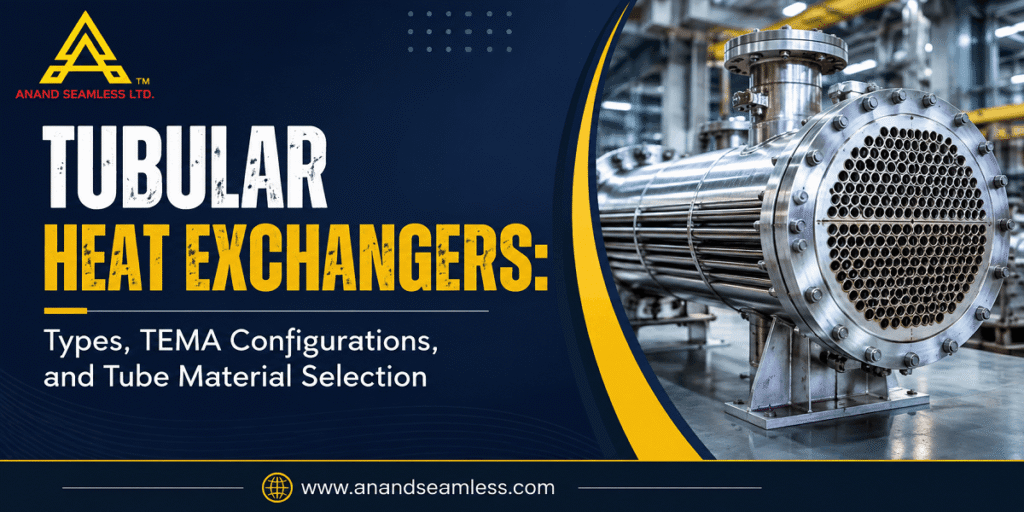
A tubular heat exchanger (shell-and-tube heat exchanger) has one fluid flowing inside seamless tubes and another flowing around the tubes inside a cylindrical shell. Four types are used in Indian industrial service: fixed tubesheet, floating head, U-tube, and double pipe (hairpin) — each governed by TEMA standards and ASME Section VIII, with specific tube material grades for each service condition.
Tubular heat exchangers hold a 37% revenue share of the global heat exchanger market ($6.7 billion in 2024, projected $9.2 billion by 2030) because they handle conditions that destroy plate exchangers: pressures above 300 bar, temperatures exceeding 600°C, corrosive fluids, and high-fouling process streams. For procurement engineers on ONGC, HPCL, IOCL, BHEL, and EPC-contracted projects in India, selecting the correct type and tube material is a fundamental specification decision that affects procurement cost, maintenance schedule, and equipment life.
What Is a Tubular Heat Exchanger?
“Tubular heat exchanger” is used interchangeably with “shell-and-tube heat exchanger” in most Indian project specifications and procurement documents. The TEMA (Tubular Exchanger Manufacturers Association) standard — currently in its 2024 edition — governs the design, fabrication, and maintenance of tubular heat exchangers. TEMA uses a three-letter designation code: first letter = front-end head type, second = shell type, third = rear-end head type. Common examples: BEM (bonnet, single-pass shell, fixed tubesheets), AES (channel with removable cover, single-pass shell, floating head), BEU (bonnet, single-pass shell, U-tube rear end).
Fixed Tubesheet Tubular Heat Exchangers (TEMA BEM, NEN, AEL)
Fixed tubesheet exchangers have both tubesheets welded directly to the shell — the tube bundle cannot be removed. This is the simplest and least expensive tubular heat exchanger configuration. The trade-off: the shell side can only be cleaned chemically (no mechanical access), and the design must manage differential thermal expansion between the tube bundle and the shell through the tube wall or via an expansion bellows.
When fixed tubesheet is the correct specification: temperature differential between tube-side and shell-side fluids is typically less than 50°C (no expansion joint required), and the shell-side fluid is clean enough that mechanical cleaning is not required. On Indian EIL and HPCL project specifications, BEM is the default for cooling water, steam heating of clean process fluids, and process gas cooling.
Common TEMA types: BEM (bonnet front head, E shell, M rear — fixed tubesheet, most economical); AEL (channel with removable cover, E shell, L rear — fixed tubesheet with removable cover, allows tube-end inspection without disturbing nozzle piping); NEN (no packed joints, both heads integral with tubesheets — for very high tube-side pressure above 150 bar where every joint is a potential leak point).
Tube material: SA-179 cold drawn carbon steel is the standard for fixed tubesheet heat exchangers in non-corrosive service below 370°C. For clean steam-heated service, SA-192 minimum-wall specification is required under IBR (Indian Boiler Regulations) when the exchanger is part of an IBR steam circuit.
Floating Head Tubular Heat Exchangers (TEMA AES, BES, AET)
Floating head exchangers have the front tubesheet fixed to the shell and the rear tubesheet free to move (“float”) axially inside the shell, accommodating unlimited differential thermal expansion regardless of temperature differential. The tube bundle can be completely withdrawn from the shell for full mechanical cleaning — both shell interior and tube bores are accessible. This combination makes the floating head configuration the standard specification for fouling refinery process service in India.
When floating head is the correct specification: EIL, HPCL, and IOCL project specifications default to floating head (TEMA AES or BES) for all fouling refinery process service — crude preheat, hydrotreater feed-effluent exchangers, heavy oil coolers, amine solution coolers, and any service where the temperature differential exceeds approximately 50°C or where both tube-side and shell-side fluids have fouling tendency. TEMA R class applies.
Common TEMA types: AES (channel with removable cover, E shell, S rear — split backing ring floating head, most common in Indian refinery service); BES (bonnet front head, E shell, S rear floating head — similar to AES but with bonnet front head, lower cost); AET (channel with removable cover, E shell, T rear — pull-through bundle, allows the tube bundle to be pulled through the shell without dismantling the rear head).
Tube material: SA-179 or SA-192 carbon steel for clean process service; SA-213 T11 (1.25Cr-0.5Mo) or T22 (2.25Cr-1Mo) for service above 370°C or where Nelson curve compliance is required for hydrogen service; TP304L or TP316L stainless steel for corrosive tube-side service including amine regenerator reboilers, sour water strippers, and chemical plant heat exchangers.
U-Tube Tubular Heat Exchangers (TEMA BEU, AEU)
U-tube exchangers have all tubes bent into U-shapes, both tube ends terminating at the same tubesheet at the front of the shell. The U-bend end is completely free — no rear tubesheet, no floating head, no expansion joint — giving U-tube designs unlimited thermal expansion at the lowest cost of any removable-bundle configuration. The bundle can be withdrawn for shell-side mechanical cleaning. Limitation: the U-bend zone cannot be mechanically cleaned, restricting U-tube designs to clean tube-side service.
When U-tube is the correct specification: U-tube (TEMA BEU or AEU) is standard for steam reboilers, feedwater heaters, and high-temperature clean-service heat exchangers where the tube-side fluid is clean (steam, condensate, clean process water) and shell-side mechanical cleaning is required but tube-side mechanical cleaning is not. On Indian HPCL and IOCL projects, BEU is standard for all steam-heated reboilers in distillation column service.
U-tube tube material: SA-179 cold drawn carbon steel for steam reboiler and clean process service; TP316L stainless steel for U-bend tubes in amine and sour service, with mandatory stress-relief annealing to prevent stress corrosion cracking at the bend zone. Anand Seamless supplies finished U-bend tubes in SA-179, SA-192, SA-213 T11/T22, and TP316L with IBR Form III-C certification for Indian heat exchanger fabricators.
Double Pipe (Hairpin) Heat Exchangers
Double pipe heat exchangers consist of one tube inside another — the inner tube carries one fluid, and the annular space between the inner and outer tube carries the other fluid. Multiple hairpin sections can be connected in series or parallel to achieve the required thermal duty. Double pipe exchangers are not classified under TEMA; they are designed per ASME B31.3 (Process Piping) for the tube and ASME Section VIII for the outer pipe when it is a pressure vessel.
When double pipe is the correct specification: Double pipe exchangers are used for small-capacity process streams where a full multi-tube bundle would be severely oversized, for very high tube-side pressures (above 300 bar) where multi-tube tubesheet design becomes impractical, and for true counter-current flow where the closest temperature approach is required. In Indian refinery and petrochemical projects, double pipe exchangers appear in sample cooler applications and as trim coolers.
Tubular Heat Exchanger vs Plate Heat Exchanger: When to Specify Each
Specify tubular when: operating pressure exceeds 25–30 bar; process temperature exceeds 200°C; the fluid is fouling and requires periodic mechanical tube cleaning; the fluid is corrosive (TP316L, titanium — available in tube form, difficult in plate form); or the fluid is toxic or hazardous where gasket leakage between plate channels is unacceptable. For a detailed comparison, see our shell-and-tube vs plate heat exchanger comparison guide.
Specify plate when: the duty is clean liquid-to-liquid heat exchange at moderate pressure and temperature; compactness and thermal efficiency per unit footprint are critical; the fluids are non-fouling and can be cleaned in-place (CIP); and the duty requires very close temperature approach (plate exchangers can achieve 1–2°C approach temperature vs 5–10°C minimum for most tubular designs).
TEMA Class R, C, and B — Which Applies to Indian Projects?
TEMA R (Refinery class): The most conservative class, mandatory for all process service heat exchangers on Indian EIL-contracted refinery and petrochemical projects. TEMA R specifies minimum tube wall 2.11 mm (BWG 14) for carbon steel, minimum corrosion allowance 3.2 mm, and stringent joint quality requirements.
TEMA C (Commercial class): Less conservative than TEMA R, designed for general commercial and process service. Used for utility heat exchangers — cooling water coolers, steam heaters, and non-critical process service — on the same Indian refinery project where TEMA R applies to process heat exchangers.
TEMA B (Chemical class): Intermediate between R and C, designed for chemical process service. Used by Indian chemical plant and specialty chemical projects. Less commonly specified than TEMA R in mainstream Indian oil and gas and refinery projects.
Tube Material Selection by Tubular Heat Exchanger Type
| Exchanger Type | TEMA Code | Standard Tube Material | Corrosive Service | Indian Application |
|---|---|---|---|---|
| Fixed Tubesheet | BEM, AEL, NEN | SA-179 / SA-192 | TP304L / TP316L | Cooling water, steam heating, clean process gas |
| Floating Head | AES, BES, AET | SA-179 / SA-213 T11/T22 | TP304L / TP316L | Crude preheat, hydrotreater, amine coolers, fouling service |
| U-Tube | BEU, AEU, BKU | SA-179 (steam reboiler) | TP316L (stress-relieved bends) | Steam reboilers, feedwater heaters, kettle evaporators |
| Double Pipe | — (ASME B31.3) | SA-179 / SA-106 Gr B | TP316L / titanium | Sample coolers, high-pressure service, trim coolers |
| Kettle Reboiler | AKU, BKU | SA-179 (clean bottoms) | SA-213 T11/T22 (high temp) | Distillation column reboilers, LPG service |
Tubular Heat Exchanger Tubes from Anand Seamless
Anand Seamless manufactures cold drawn carbon steel seamless tubes in SA-179 and SA-192 and alloy steel seamless tubes in SA-213 T11 and T22 for tubular heat exchanger bundle applications across all four types. We also supply finished carbon steel U-bend tubes and alloy steel U-bend tubes for U-tube bundle configurations. We hold IBR Well Known Maker status, ISO 9001:2015 certification, and EIL vendor approval, with EN 10204 Type 3.1 or 3.2 MTRs.
Contact our technical team at +91 90999 96853 or +91 99099 68550, or email inquiry@anandseamless.com with your TEMA type, tube grade, OD, wall thickness, quantity, and project documentation requirements.
Frequently Asked Questions
Q: What is a tubular heat exchanger and how does it differ from a plate heat exchanger?
A: A tubular heat exchanger (shell-and-tube heat exchanger) transfers heat across the wall of seamless tubes — one fluid inside the tubes, another outside in a cylindrical shell. A plate heat exchanger transfers heat across corrugated metal plates. Tubular heat exchangers are specified for high-pressure (above 25–30 bar), high-temperature (above 200°C), fouling, corrosive, and hazardous fluid service. Plate exchangers are preferred for clean liquid-to-liquid duties requiring compact size and close temperature approach.
Q: What is the difference between TEMA R, C, and B classes for tubular heat exchangers?
A: TEMA R (Refinery class) is the most conservative — mandatory for all process service heat exchangers on Indian EIL, HPCL, and IOCL refinery and petrochemical projects. It specifies minimum tube wall 2.11 mm for carbon steel and minimum corrosion allowance 3.2 mm. TEMA C (Commercial class) is used for utility heat exchangers on the same projects. TEMA B (Chemical class) applies to chemical process service.
Q: When should a floating head tubular heat exchanger be specified instead of a fixed tubesheet?
A: Specify floating head (TEMA AES or BES) when: the temperature differential between tube-side and shell-side exceeds approximately 50°C; the fluid is fouling and requires periodic mechanical cleaning with bundle withdrawal; or the service falls under TEMA R refinery class where EIL project specifications mandate floating head for process service. Fixed tubesheet (BEM or NEN) is appropriate for clean service with moderate temperature differential and low fouling on both sides.
Q: What tube material is standard for floating head tubular heat exchangers in Indian refinery service?
A: SA-179 cold drawn carbon steel is standard for clean non-corrosive process service below 370°C. SA-213 T11 or T22 is specified above 370°C or for hydrogen service requiring Nelson curve compliance. TP304L or TP316L stainless steel is specified for corrosive tube-side service — amine regenerator reboilers, sour water strippers, and chemical plant heat exchangers where carbon steel corrosion rates are unacceptable.
Q: Can a double pipe heat exchanger be used for high-pressure service in Indian petrochemical plants?
A: Yes — double pipe (hairpin) heat exchangers are well-suited to very high tube-side pressures (above 300 bar) where multi-tube tubesheet design becomes impractical. The inner tube handles the high-pressure fluid; the outer pipe (ASME Section VIII pressure vessel) contains the lower-pressure fluid. Used in Indian refinery hydrogen make-up gas service and high-pressure reactor feed applications.
Q: Does Anand Seamless supply SA-179 and alloy steel tubes for all types of tubular heat exchangers?
A: Yes. Anand Seamless manufactures cold drawn seamless tubes in SA-179, SA-192, SA-213 T11, and T22 for fixed tubesheet, floating head, U-tube, kettle reboiler, and double pipe heat exchanger bundle applications, plus finished U-bend tubes for U-tube configurations. We hold EIL vendor approval, IBR Well Known Maker status, and ISO 9001:2015 certification, supplying with EN 10204 Type 3.1 or 3.2 MTRs.